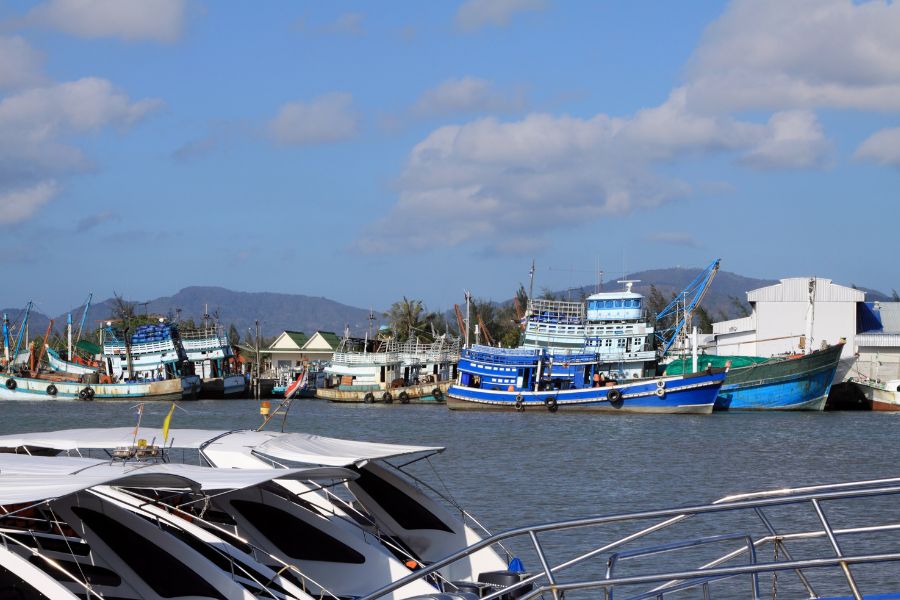
Travelling from Railay to Phuket is relatively straightforward, but the best option depends on whether you prioritise speed, price, convenience, or flexibility.
The most practical choices are a direct speedboat or ferry from Railay East, a longtail boat followed by an overland transfer via Ao Nang, or a private car or van transfer after crossing to the mainland.
For most travellers, the direct boat is the simplest choice during the dry season. During periods of rough seas or heavy rain, however, an overland transfer can be a more reliable alternative.
Railay to Phuket at a Glance
| Option | Typical travel time | Approx. price | Best for |
|---|---|---|---|
| Direct speedboat/ferry | 1h 15m–1h 45m on the water | THB 800–1,650 | Most travellers |
| Longtail + road transfer | Around 3–4 hours | From about THB 2,500+ per vehicle | Flexibility and groups |
| Shared longtail + minivan | Around 3–5 hours | Usually less than private transfer | Budget travellers |
| Private longtail + private car/van | Around 3–3.5 hours | Roughly THB 3,000–4,500+ | Families and groups |
Actual fares and departure times vary by season, operator and destination pier. Current September 2026 schedules show several direct departures from Railay East to Rassada Pier, with journey times of approximately 1h 15m to 1h 45m.
1. Direct Speedboat or Ferry from Railay to Phuket
For most travellers, the direct boat is the easiest way to travel between Railay and Phuket.
Services generally depart from the floating pier at Railay East and arrive at Rassada Pier in Phuket. Depending on the service, other Phuket piers may also be available.
Current schedules show departures around late morning and afternoon. For example, September 2026 schedules include:
- 11:10 → 12:30 — Bundhaya Speed Boat
- 12:45 → 14:30 — Andaman Wave Master
- 15:15 → 16:30 — Andaman Wave Master
These services operate daily on the currently published schedule, although departure times can change with the season.
Typical cost
Expect approximately THB 800–1,650 per person, depending on the operator, departure time, boat type and booking conditions. Published 2026 schedules show fares around THB 800–1,060 for some services, while other departures are priced closer to THB 1,400–1,650.
Where does the boat leave from?
The important detail is that Railay has no road connection.
Most Phuket-bound services use the Railay East floating pier, rather than departing directly from the sand at Railay West. Depending on the tide and operator, passengers may need to use a short longtail transfer to reach the boat.
Allow extra time for boarding, particularly if travelling with large luggage.
Advantages
- Fastest and simplest option
- No road transfer required
- Direct connection to Phuket
- Scenic journey across the Andaman Sea
- Several departures may be available during the main season
Disadvantages
- Dependent on sea and weather conditions
- Boats can be uncomfortable in rough seas
- Limited luggage space on some speedboats
- Fewer options during the low season
2. Railay → Ao Nang by Longtail + Phuket by Road
If the sea conditions are poor, or if a suitable direct boat is not available, travelling overland can make more sense.
The first step is to take a traditional longtail boat from Railay to Ao Nang.
The crossing takes approximately 10–15 minutes. Shared longtails are around THB 100 per person one way, although fares can vary depending on the departure point, time and conditions.
Once in Ao Nang, continue to Phuket by minivan, taxi or private car.
The road journey from the Krabi/Ao Nang area to Phuket generally takes approximately 2.5–3.5 hours, depending on traffic and the final destination in Phuket. Current 2026 transfer listings show private cars and vans from the Krabi area starting at roughly THB 2,300–3,500, depending on vehicle type and destination.
Approximate journey
Railay → Ao Nang by longtail
10–15 minutes
Ao Nang → Phuket by road
Approximately 2.5–3.5 hours
Total: approximately 3–4 hours, excluding waiting time.
This option is particularly useful if the final destination is a Phuket hotel rather than Rassada Pier.
3. Private Transfer: Railay → Phuket Hotel
A private transfer is the most convenient road-based option for families, groups or travellers with substantial luggage.
Because Railay has no road access, the journey still begins with a boat.
The usual arrangement is:
Railay → Ao Nang by longtail → private car or van → Phuket hotel
A private vehicle from the Krabi/Ao Nang area to Phuket can cost roughly THB 2,300–3,500+, depending on whether you choose a car, SUV or van and where you are staying in Phuket.
For a group of four to six people, the higher upfront price can become reasonable when divided between passengers.
Advantages
- Hotel-to-hotel convenience
- No need to change vehicles in Phuket
- More luggage space
- Flexible departure time
- Useful for families and groups
Disadvantages
- More expensive than travelling by boat
- Still requires a short boat crossing from Railay
- Road travel takes longer than a direct speedboat
4. Railay → Krabi Town → Phuket
Another possibility is to travel from Railay to Krabi Town before continuing to Phuket.
This can work if you already need to visit Krabi Town, but it is generally not the most efficient route when Phuket is the final destination.
For a straightforward Railay-to-Phuket journey, the two practical choices are usually:
Railay → Phuket by direct boat
or
Railay → Ao Nang → Phuket by road
Adding Krabi Town creates another transfer without providing a major advantage for most travellers.
Direct Boat vs Private Transfer
| Factor | Direct boat | Private road transfer |
| Speed | Excellent | Good |
| Convenience | Excellent | Excellent |
| Cost for 1 person | Lower | Much higher |
| Cost for groups | Moderate | More reasonable when shared |
| Luggage | Limited/moderate | Excellent |
| Weather dependence | High | Lower |
| Hotel drop-off | Usually requires onward transport | Yes |
| Scenic experience | Excellent | Moderate |
| Best season | Dry season | Year-round |
Which Phuket Pier Should You Choose?
The arrival pier matters because Phuket is much larger than Railay.
Rassada Pier
Rassada Pier is one of the main ferry terminals serving Phuket and is a common arrival point for services from Railay.
It is convenient for travellers staying around:
- Phuket Town
- Chalong
- Patong, depending on onward traffic
- Kata and Karon, with a further road transfer
If your hotel is on the west coast, remember that arriving at Rassada Pier does not mean the journey is finished.
Bang Rong Pier
Bang Rong is on the north-eastern side of Phuket and can be more convenient for travellers staying in northern Phuket or travelling onward towards areas such as Bang Tao.
Always check the arrival pier before booking because the most convenient pier depends heavily on your accommodation.
What Is the Cheapest Way from Railay to Phuket?
The cheapest route depends on the day and available connections.
A shared longtail from Railay to Ao Nang can cost around THB 100 per person, after which travellers can continue by shared minivan or bus to Phuket.
This can reduce the cost substantially compared with a direct speedboat, although it involves more transfers and takes longer.
For travellers prioritising convenience, the cheapest ticket is not necessarily the best value. A direct boat costing a few hundred baht more can save several hours and eliminate multiple transfers.
What Is the Fastest Way from Railay to Phuket?
A direct speedboat or ferry is normally the fastest option.
Current schedules show direct sea journeys of approximately 1h 15m–1h 45m, although the overall journey will be longer once check-in, boarding and the transfer from the Phuket pier to your hotel are included.
For a hotel in Patong, Kata, Karon or another west-coast area, allow additional road-transfer time after reaching Phuket.
Is the Direct Boat Available All Year?
Direct services are more seasonal than road transfers.
The Andaman Sea can become rough during the southwest monsoon, particularly between approximately May and October. Boat schedules can be reduced, changed or cancelled when weather conditions are unsuitable.
If travelling during the wetter months, check the service status close to departure and keep an overland option in mind.
Road transfers are generally the safer choice when sea conditions are poor.
Practical Tips for the Journey
1. Check the departure pier carefully
Railay has different landing points and there is no road connection. Confirm whether your ticket departs from Railay East or requires a short longtail transfer.
2. Allow extra time for luggage
Moving luggage between beaches, longtails and speedboats is considerably less convenient than a normal road transfer.
A small wheeled suitcase may be manageable, but a backpack or soft-sided luggage is often easier.
3. Keep valuables protected
When using a longtail, passengers may need to step through shallow water when boarding or landing, particularly at beach landing points.
A waterproof bag for passports, phones and electronics is useful.
4. Do not schedule a tight flight connection
If flying from Phuket International Airport on the same day, avoid relying on the final available boat.
A boat delay caused by weather can have a much greater impact than a road delay.
For an important flight, travelling to Phuket the previous day is the safer option.
5. Consider your Phuket hotel location
Rassada Pier is not close to every Phuket resort area.
A direct boat may be the fastest way to Phuket itself but not necessarily the fastest way to your hotel.
For example, someone staying in northern Phuket may find a Bang Rong arrival more convenient, while a traveller staying near Phuket Town may prefer Rassada.
Recommended Option by Traveller Type
For first-time visitors:
Choose the direct boat if the schedule fits your plans and the weather is favourable.
For budget travellers:
Take a shared longtail to Ao Nang and continue by shared road transport.
For families:
Consider a private car or van after the short longtail crossing. The additional cost can be worthwhile for luggage and door-to-door convenience.
For groups of four or more:
Compare the total cost of a private vehicle rather than automatically buying individual ferry tickets.
For travellers during the rainy season:
Keep an overland transfer as a backup and avoid planning an important flight immediately after a sea crossing.
Final Recommendation
For most travellers, the direct Railay-to-Phuket boat is the best overall option when the sea is calm and the departure time suits the itinerary. Current schedules show several daily departures during the September 2026 period, with fares generally ranging from around THB 800 to THB 1,650 and sailing times of roughly 1h 15m to 1h 45m.
The longtail + road-transfer option is better when flexibility, hotel drop-off or weather reliability matters more than speed.
For families and larger groups, a private road transfer from Ao Nang to Phuket can also be good value when the cost is divided among several passengers.
The key is to choose the route based not only on the ticket price, but also on the season, sea conditions, luggage, Phuket hotel location and onward travel plans.
Frequently Asked Questions
1. How long does it take to travel from Railay to Phuket?
A direct boat usually takes approximately 1h 15m–1h 45m on the water. Allow additional time for boarding and the journey from the Phuket pier to your hotel.
2. How much does the Railay to Phuket ferry cost?
Current published fares generally range from approximately THB 800–1,650 per person, depending on the operator, boat and departure time.
3. Where do boats from Railay to Phuket depart?
Most direct services depart from the Railay East floating pier. Check your ticket carefully because boarding arrangements can vary with the tide and operator.
4. Where do boats from Railay arrive in Phuket?
Rassada Pier is a common arrival point. Some services may use other piers, so check the arrival location before booking.
5. Can I travel from Railay to Phuket by longtail boat?
Yes, but a longtail is normally only the first part of the journey. Take a longtail from Railay to Ao Nang, then continue to Phuket by road.
6. How much is the longtail boat from Railay to Ao Nang?
A shared longtail is approximately THB 100 per person one way, although fares and operating conditions can change. The crossing takes around 10–15 minutes.
7. Is Railay to Phuket better by boat or road?
The boat is generally faster and simpler when conditions are good. Road transport is preferable when the sea is rough, when travelling with substantial luggage, or when direct boat schedules do not fit your itinerary.
8. Is the Railay to Phuket ferry available during the rainy season?
Some services operate during the rainy season, but schedules can be reduced and crossings may be affected by weather and sea conditions. Always check the latest departure status before travelling.
9. Can I travel directly from Railay to Phuket Airport?
There is no road from Railay, so the journey requires a boat first. You can either take a direct boat to Phuket and continue by road, or take a longtail to the mainland and arrange a private road transfer to Phuket Airport.
10. Should I book the Railay to Phuket boat in advance?
Advance booking is sensible during busy periods, particularly if you need a specific departure time or have a flight to catch. During quieter periods, there may be more flexibility, but travellers should still check the current timetable because services are seasonal.
For a Complete Travel Guide
For more detailed information on transportation options, booking tips, itinerary suggestions, and everything you need to know about planning your trip, visit our full guide:
